

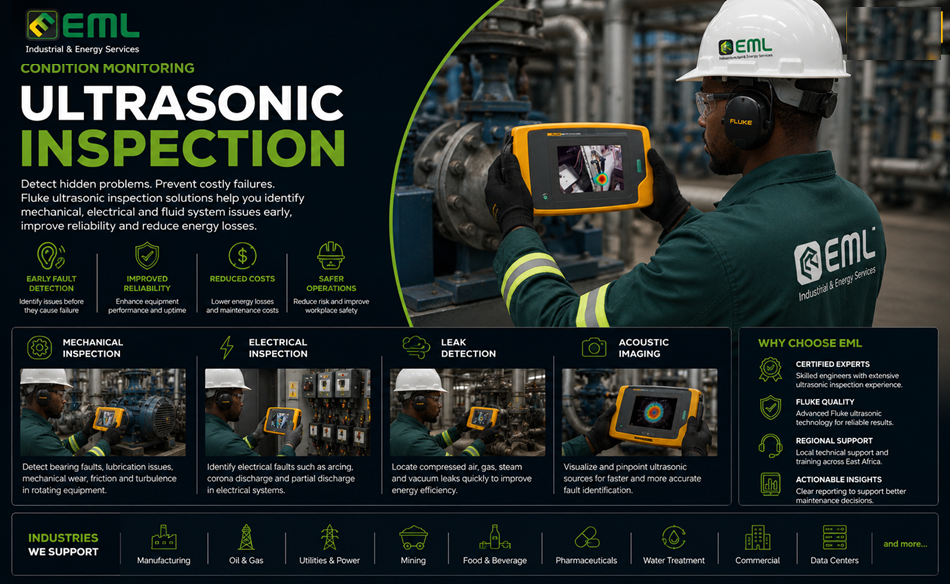
Ultrasonic Inspection is an advanced condition monitoring technique used to detect hidden mechanical, electrical, and fluid system abnormalities before failure occurs. Using advanced Fluke ultrasonic and acoustic imaging technologies, EML helps industries identify developing faults early, improve equipment reliability, reduce energy losses, and strengthen predictive maintenance programs across industrial facilities.


Advanced Ultrasonic Diagnostic Solutions
EML provides professional ultrasonic inspection solutions using advanced Fluke technologies for industrial diagnostics, predictive maintenance, leak detection, electrical inspection, and asset reliability improvement. Our solutions support both handheld ultrasonic detectors and advanced acoustic imaging systems for fast and accurate fault identification.
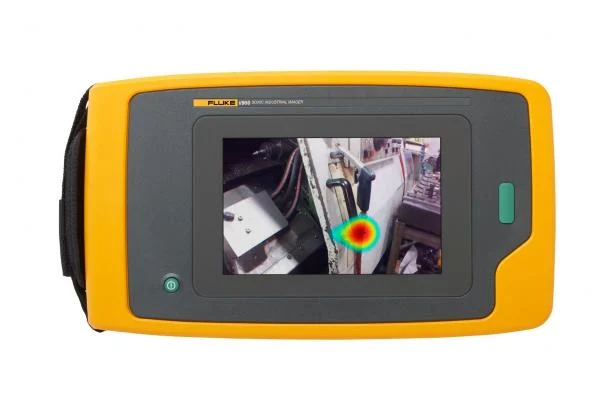
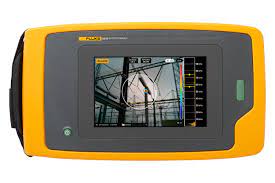
Technologies such as the Fluke ii905 and Fluke ii910 Acoustic Imagers allow maintenance teams to visually locate ultrasonic sources in real time, significantly improving inspection speed, fault localization, and maintenance efficiency.
Ultrasonic inspection is highly effective in detecting problems that may not yet be visible through vibration analysis, thermography, or conventional visual inspections.
Mechanical & Rotating Equipment Inspection
Fluke ultrasonic technologies are widely used for monitoring bearings, lubrication conditions, rotating equipment, and mechanical wear. High-frequency sound analysis helps maintenance teams detect friction, turbulence, impact, and early-stage component degradation before catastrophic failure occurs.
Our ultrasonic inspection solutions support diagnostics on:


Electrical Inspection & Arc Detection
Fluke ultrasonic inspection solutions are highly effective for identifying electrical faults such as arcing, tracking, corona discharge, and partial discharge in medium and high-voltage electrical systems. These faults often generate ultrasonic sound long before visible failure or thermal abnormalities appear.
EML supports ultrasonic electrical inspections for:
Advanced acoustic imaging technologies such as the Fluke ii910 enable maintenance teams to quickly scan electrical systems and visually identify ultrasonic discharge sources from safe distances, improving both inspection safety and operational reliability.


Compressed Air & Gas Leak Detection
Compressed air leaks represent one of the largest hidden energy losses within industrial facilities. Fluke ultrasonic leak detection solutions enable maintenance teams to quickly locate compressed air, gas, steam, and vacuum leaks with high precision, even within noisy industrial environments.
Using acoustic imaging technology, organizations can dramatically reduce leak detection time while improving energy efficiency and reducing operational costs.
Fluke acoustic imagers are especially effective for:


Acoustic Imaging & Advanced Monitoring
EML provides advanced Fluke acoustic imaging solutions capable of visually locating ultrasonic sources in real time. These technologies dramatically reduce inspection time and improve fault localization for large industrial systems, electrical installations, and complex process environments.
Combined with predictive maintenance workflows, digital reporting, and EMLOnline integration, ultrasonic inspection solutions help organizations improve maintenance efficiency, asset reliability, and operational performance.


Integrated Condition Monitoring
Ultrasonic inspection is often integrated with thermography, vibration monitoring, power quality analysis, environmental monitoring, and motor testing to provide a comprehensive condition monitoring solution for industrial facilities.
This integrated diagnostic approach provides deeper visibility into equipment condition while supporting data-driven maintenance planning, reliability improvement, and proactive asset management strategies.
Industries Supported
EML supports Fluke ultrasonic inspection applications across manufacturing, utilities, oil & gas, mining, food & beverage, pharmaceuticals, water treatment facilities, commercial buildings, power generation, and data center environments where operational reliability and energy efficiency are critical.